 |
Precision Machining of Advanced Materials
Editor: Liangchi Zhang
202 pages, Illustrations, soft cover,
Trans Tech Publications
Available from Abrasives Mall
$80USD plus S&H
Price may be subject to change.
|
The latest in a series of compilations edited by Dr. Zhang, professor of Mechanical Engineering at the University of Sydney. As volume 196 of the Key Engineering Materials series published by TransTech Publications, this 202-page
book reflects the latest developments in machining of advanced materials in terms of both theoretical and practical discussions. Other books edited by Dr. Zhang include:Advances in Abrasive Technology
Abrasives Technology: Development and Applications. Contact the Abrasives Mall for more information.
| NOTE: Many papers in this book are available as separates. Priced at $12 for the first paper and $4 for each additional in the same order. Contact the Abrasives Mall for details. |
Examples of topics and summary of a few research findings:
 Abrasive Jet Printer. A new nozzle design will greatly extend the capabilities of abrasive jet machining in making blind holes. A high speed solenoid pulses abrasive entrainment in 10 millisecond bursts allowing time for the main air jet to remove loose materials from hole bottoms for faster and better control of machining. The nozzle makes possible an abrasive jet printer that etches ceramics and other materials directly without costly masking. Illustrating precision capabilities, the abrasive jet printer etched glass in 64 different levels to yield an graphic image in 80 dpi resolution.
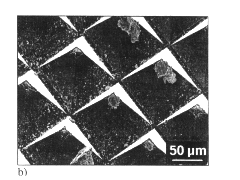 Structured Superabrasives. Though structured coated abra-sives made with aluminum oxide and silicon carbide have been around for years (eg. Norax or Trizac), similar product containing superabrasives are still being developed. In tests at Angstrom Laboratory, Sweden, structured superabrasives made using a wafer patterning technology bested silicon carbide abrasives particularly when finishing alumina ceramics. Silicon carbide was best, however, when grinding brass.
Diamond Tools. The greentape laser sintering system appears to be a way to make better tools. As demonstrated in tests polishing austenite stainless steel with copper-bonded aluminum oxide or CBN, advantages of such tools are high porosity, flexibility to include a wide range of abrasives, and the ability to make hybrid structures.
Wear on Diamond Tools. A thermodynamic analysis of the wear of diamond tools
when machining steels considered four possible thermo-chemical mechanisms.
Findings include two significant mechanisms that depend upon temperature and partial pressure of oxygen in work environment.
Workpiece burn. Studies of grinding burn in new DZ4 nickel-based alloys, which are being used for aircraft turbines, show the ratio of normal to tangential grinding forces is an easy way to determine the onset of grinding burn.
ELID. ELID grinding produces good surface characteristics on CVD -SiC films. Tools finished with ELID have wear rates that are less dependent upon the lay of surface finishes. Also wear is minimal when contract pressures are below a critical maximum value, which is coincident with a transition from powder to nonpowder wear mechanisms.
A COMPLETE TABLE OF CONTENTS APPEARS BELOW
Some technical papers are available as separates. Contact the Abrasives Mall for specifics.
To order contact the Abrasives Mall. Credit card payment preferred. Call or fax 724-282-6210 with card information. Additional fees required for shipment outside the US.
TABLE OF CONTENTS
- Mechanisms
- Essential Aspects of Chemical Mechanical Planarization for Oxide Semiconductor by H Hocheng, H Y Tsai, Y L Huan..1
- A Noval Chemical-Mechanical Planarization Technology Using Pre-Thin-Surface Grinding in ULSI Manufacturing Process by J Watanabe, R Etoh, M Hirano..25
- Handling the Molecular Dynamics Simulation for Nano-Machining
D Cheong, H Tanaka, L Zhang . 31
- The Exit Defects in Drilling Carbon Fibre-Reinforced Plastics
H Zhang, W Chen, D Chen, L Zhang .. 43
- Grinding of Ceramics: Strength, Surface Features and Grinding Conditions
T Liu, B A Latella and L Zhang..53
- Grinding Burn Mechanism of Directionally Solidified Superalloy
M Chen, F Sun, B Xue .. 61
- Friction and Wear
- Wear Mechanism of Diamond Cutting Tool in Machining of Steel
H Tanaka, S Shimada, N Ikawa, M Yoshinaga . 69
- A Friction Model for Free-Machining Steels and Its Applicability
to Machinability Analysis
K Maekawa, A Kubo, T H C Childs .. 79
- mprovement of Friction and Wear Properties of CVD-SiC Films
with New Surface Finishing Method “ELID-Grinding”
T Kato, H Ohmori, C Zhang, T Yamazaki, Y Akune, K Hokkirigawa .. 91
- Methods and Tools
- A New Device of Abrasive Jet Machining and Application
to Abrasive Jet Printer T Kuriyagawa, T Sakuyama, K Syoji, H Onodera . 103
- On-Machine Monitoring of the Wheel Working Surface Condition
with the Relative Frequency Distribution of Its Profile
S Shimizu, H Sakamoto .. 111
- On-Machine Monitoring of the Wheel Working Surface Condition
with the Fractal Dimension Analysis of Its Profile
H Sakamoto, S Shimizu .. 121
- Fabrication of Metal-Bonded Grinding/Polishing Tools
by Green Tape Laser Sintering Method
K Maekawa, Y Yokoyama, I Ohshima .. 133
- Abrasive Capacity of Thin Film Diamond Structures
J Andersson, P Hollman, S Jacobson .. 141
- Micro Hole Machining of Borosilicate Glass through Electrochemical
Discharge Machining (ECDM)
C T Yang, S S Ho, B H Yan .. 149
- Micro-Spherical Lens Mold Fabrication by Cup-Type Metal-Bond
Grinding Wheels Applying ELID (Electrolytic In-Process Dressing)
T Matsuzawa, H Ohmori, C Zhang, W Li, Y Yamagata,
S Moriyasu, A Makinouchi .. 167
- Threading of Inclusion Modified Steels with Coated Carbide Tools
E Ezugwu, C I Okeke .. 177
- CVD Diamond Coating Technologies and Application
in Cutting Abrasive Materials
M Chen, F Sun, Z Zhang . 193
To order contact the Abrasives Mall. Credit card payment preferred. Call or fax 724-282-6210 with card information. Additional fees required for shipment outside the US.
RETURN
© 20001
rev 10/20/01